Starting a website often starts with the question of whether to opt for free or paid hosting.
Free hosting offers an easy way to test an idea or a small project, but it comes with significant limitations that can slow down site growth and development.
When talking about the advantages, it is clear that the biggest savings is that there are no monthly costs.
For more serious projects and business sites, investing in quality hosting brings stability, better performance and a professional image.
Key items
Free hosting can be used for testing and smaller projects
Performance and control limitations make it unreliable for serious sites
Paid hosting with a verified provider provides security and stability
What is free hosting and how does it work?
Cloud hosting allows resources to be distributed across multiple servers, thus increasing site stability and availability.
Free hosting allows users to place a website on the Internet at no cost, but with certain limitations.
Definition of free hosting
Free hosting is a service that the provider offers server space without charge.
Providers usually use this service as a way to attract new users or to generate revenue through ads and additional paid options. name.provider.com).
This is the model suitable for beginners who want to learn the basics of web hosting without investing.
Basic features of free hosting
Free hosting has several common features that distinguish it from paid solutions.
Limited storage space (eg 500 MB to several GB)
Limited bandwidth which can slow down the site with more visits
Subdomains instead of your own domain
Advertisements on the site or dashboard
Minimal technical support or its complete absence
Some providers offer extras like a basic SSL certificate or a website builder, but always with clear limitations.
These features make it suitable for small projects, but limit the possibility of growth and professional use.
How it differs from premium hosting
Premium hosting is charged and offers more stable performance, more resources and more control over the server.
The comparison chart clearly shows the differences:
Element
Free hosting
Premium hosting
Price
0 €
From a few euros per month
Domain
Provider subdomain
Own domain
Resources
Limited
Scalable
Support
Minimal or none
24/7 technical support
Advertisements
Often mandatory
There are no ads
Premium hosting is intended for more serious projects, business sites and users who value security, speed and professional appearance. cannot provide the same level of reliability.
Benefits of using free hosting – Quick setup and easy for beginners!
Free cloud hosting is ideal for beginners because it allows testing applications without additional costs.
As we have already said, free hosting allows users to quickly and easily set up websites without the need for financial investment.
Low cost and affordability
The biggest advantage of free hosting is that it does not require any costs.
This option is available to everyone, regardless of whether they are students, small bloggers or people who want to explore the basics of building a site.
Some providers also offer additional free tools, such as basic themes or simple control panels.
Advantages in a nutshell:
No financial risk
Available to a large number of users
It provides the basic tools to work with
Simple registration and launch of websites
The signup process with free hosting is usually quick and streamlined.
This approach saves time and allows websites to be up and running in just a few minutes, without the need for technical knowledge or experience with servers.
Many free hosting services include pre-installed CMS platforms like WordPress.
For beginners who want to avoid complex configurations, this is a convenient way to quickly get to a functional site.
Choosing the right hosting package depends on the needs of the site - from small blogs to demanding business projects
Suitable for testing and education
Free hosting is useful for those who want to experiment with different technologies or learn the basics of website development.
The ability to test scripts or plugins at no cost gives the freedom to try different solutions before moving to paid hosting.
For educational purposes, free hosting allows you to create test sites, learn about file structure and the basics of administration.
This option also provides space to test the site's SEO settings, design and functionality in a controlled environment before publishing the project on commercial hosting.
Disadvantages and limitations of free hosting – Limited control
Free hosting often has speed, space and security limitations compared to paid options
Free hosting often attracts users due to the absence of costs, but at the same time it comes with a number of limitations.
Limited resources and performance
With free hosting, server resources are strictly limited. storage space, monthly data flow and page loading speed.
These restrictions can mean that the page loads more slowly or even becomes temporarily unavailable.
Security mechanisms with free hosting are minimal. SSL certificate, automatic backup or advanced firewall.
Reliability is also a challenge.
For users who want stability and security, free hosting is not an adequate solution.
Ads and lack of customer support
A large number of free hosting providers show ads on user websites.
In addition, users do not have access to quality customer support.
For business website owners, this situation is unfavorable because any downtime can mean a loss of visitors or revenue.
Limited functionality (eg cPanel, domains)
Free hosting rarely includes cPanel or advanced administration tools.
Domains are another limitation. mysite.com), users get a subdomain with the provider's name, which reduces professionalism.
Also, the number of available databases, e-mail accounts and installation options is often minimal.
Free hosting can be useful in certain situations, but it has its limitations that affect the performance and long-term development of the site.
Who is free hosting suitable for?
Free hosting is best suited for small sites, personal blogs and test projects
We repeat again that free hosting is usually a good choice for students, hobbyists and beginners who want to try out the basics of creating web pages.
For small personal projects, like blogs or portfolios, the free plan can provide enough resources.
However, limitations should be considered:
No own domain (provider's subdomain is used).
Advertisements appear frequently on the site.
Server speed and stability are not a priority.
Therefore free hosting is not suitable for business website or projects that require a professional image and SEO optimization.
Moving from free to premium hosting
When the site develops and attracts more visitors, the transition to premium hosting becomes a logical step.
The transition process usually includes:
Purchase of hosting packages and domain registration.
File and database migration from a free server.
Setup DNS records in order to connect the domain to the new server.
Many providers offer automatic migration tools, which makes the transition easier.
Premium hosting usually includes additional features such as an SSL certificate, advanced security options, and the ability to scale resources as the site grows.
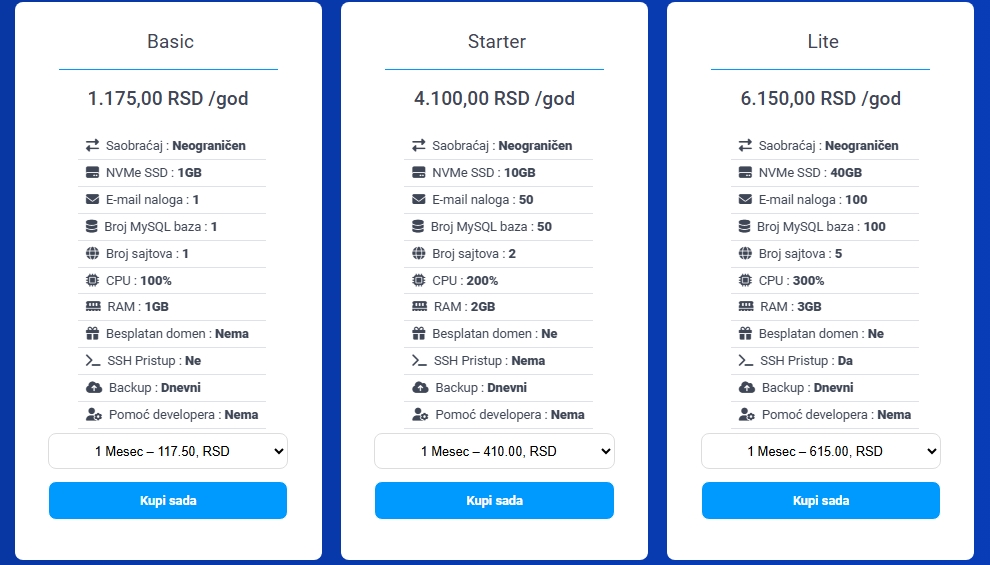
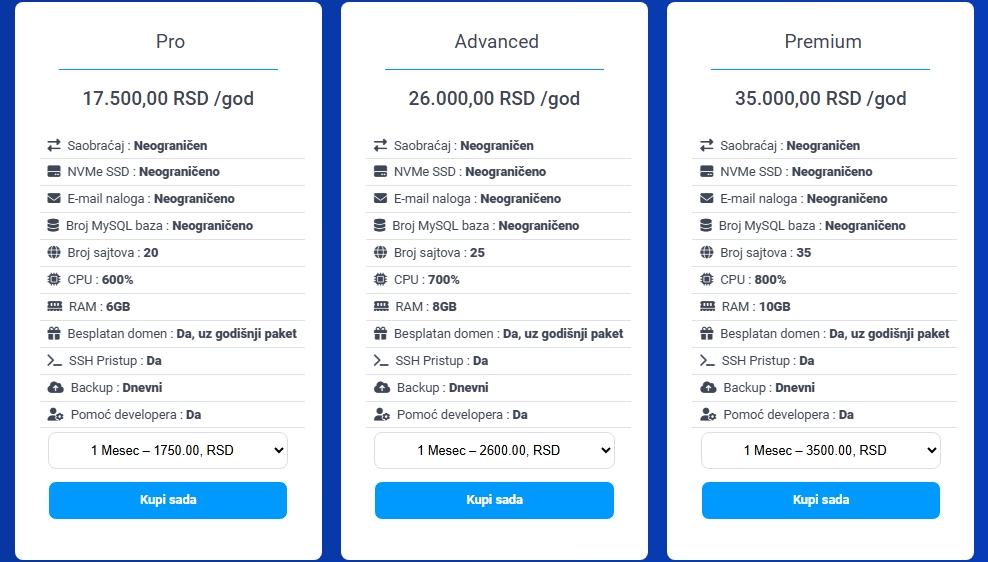
Check out our offer of business hosting packages that bring stability and speed:
Unlimited traffic and NVMe SSD space are standard in all packages
Recommendations for website owners
Website owners should evaluate their goals before choosing hosting. temporary project or testing, free hosting may be enough.
For professional sites, such as e-commerce stores or business presentations, investing in premium hosting is essential.
Comparison table can help you decide:
Characteristic
Free hosting
Premium hosting
Price
0 dinars
monthly subscription
Domain
Provider subdomain
Own domain
Technical support
Limited or none
24/7 support
SEO and branding
Poor visibility
Greater control and ranking
That way, site owners can clearly see if it's time to switch to a professional service.
Frequently Asked Questions (FAQ)
Can free hosting affect my site's SEO optimization?
Yes, it can.
Can I link my own domain to free hosting?
In most cases, no.
Can free hosting be used for an e-commerce site?
Technically yes, but not recommended.
What are the hidden costs of free hosting?
Although the basic service is free, additional options such as removing ads, more space, or technical support are often charged.
How quickly can one switch from free to paid hosting?
The migration usually takes from a few hours to a day, depending on the provider and the size of the site.
Is it possible to create a professional email account on free hosting?
Your privacy is important to us We use cookies to improve your browsing experience, deliver personalized ads or content, and analyze our traffic. cookie policy. By continuing to use the site and not selecting one of the options, you will be deemed to have opted out of the cookie policy
Functional cookies
Always active
Technical storage or access is strictly necessary for the legitimate purposes of enabling the use of a particular service that the subscriber or user has expressly requested, or solely for the purpose of transmitting communications via an electronic communications network.
Settings
Technical storage or access is necessary for the legitimate purpose of storing preferences not expressly requested by the subscriber or user.
Statistical cookies
The technical storage or access that is used exclusively for statistical purposes.Technical storage or access is required to create user profiles to send advertisements or track users on a website or across websites for similar marketing purposes.
Marketing cookies
Technical storage or access is necessary to create user profiles for the purpose of sending advertisements or tracking users on a website or across websites for similar marketing purposes.
 Skip to content