


Hosting with SSD disk vs.
SSD drives have no moving parts, unlike HDD drives, which makes them more reliable and long-lasting.
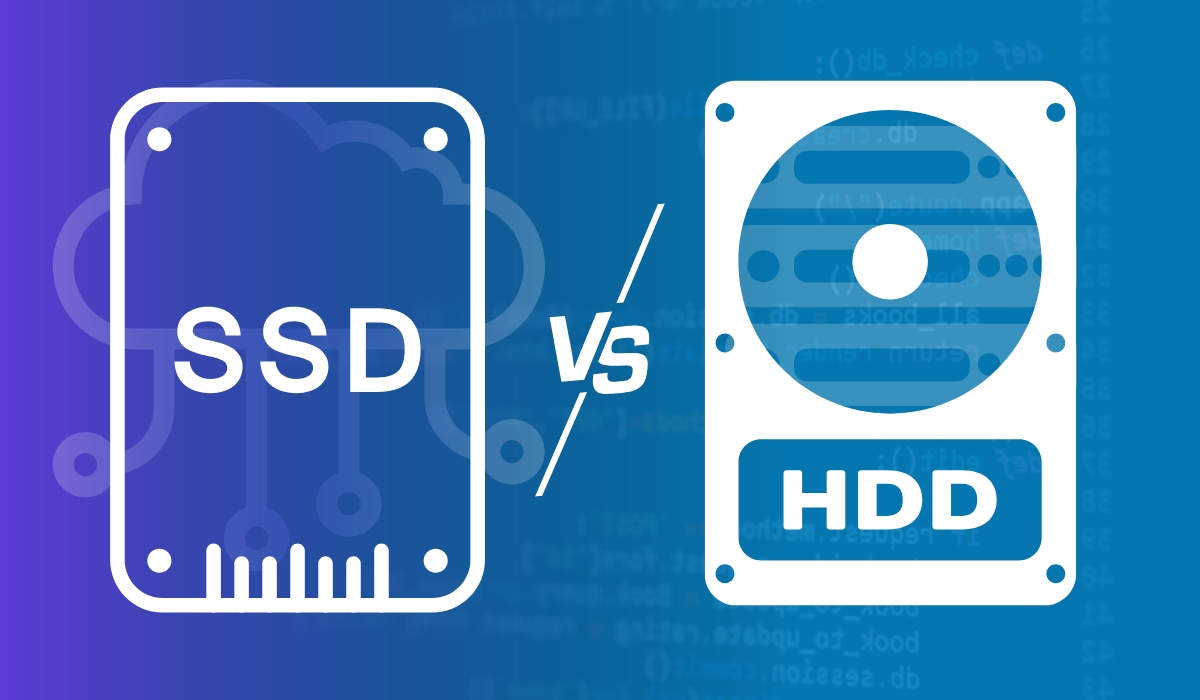
Basic differences
SSD and HDD disks represent two completely different data storage technologies that have important differences in the way they work, structure and performance.
SSD - faster data processing
SSD (Solid State Drive) uses memory chips instead of mechanical parts. flash memory similar to USB sticks, which enables fast data processing without delays caused by moving components.
Thanks to the fact that they have no moving parts, SSD drives are more resistant to physical damage and vibrations.
Data access time with SSD is measured in microseconds, while with HDD it is much longer.
HDD - cheaper and larger capacity!
HDD (Hard Disk Drive) consists of rotating magnetic disks (plotters) and read and write heads that move above their surface.
Data is stored magnetically on the HDD, and the reading speed depends on the rotation of the disks and the position of the reading head.
HDDs offer a lower price per gigabyte and are often used when more storage capacity is needed, but not maximum operating speed.
Comparative view of technologies
| Characteristic | SSD | HDD |
| Memory type | Flash memory | Magnetic disks |
| Moving parts | There is none | There is |
| Loading speed | Very tall | Much slower |
| Impact resistance | Greater | Smaller |
| Energy consumption | Lower | Higher |
| Noise during operation | Silent | Audible work |
| Price per gigabyte | Higher | Lower |
SSD drives are recommended for priority users speed and reliability, while HDDs are a tempting option when needed large amount of storage space at lower costs.
Hosting performance: SSD vs.

The biggest differences are reflected in operating speeds, system response and server capabilities to respond to a larger number of users.
Data reading and writing speed
SSD drives use flash memory, which enables significantly higher data reading and writing speeds compared to traditional HDD drives.
Typical read and write speeds of SSD drives reach up to 500 MB/s..., while HDDs usually work in the range of 80 to 160 MB/s.
Also, SSD drives have no moving parts, which is why access times are significantly shorter and less prone to lag.
Acceleration of responsiveness and site loading
SSD hosting enables faster server response time, which directly affects site loading speed and better user experience.
On sites with a high number of visits, the difference between SSD and HDD hosting can amount to a few seconds in page loading.
Data shows that sites on SSD servers have lower bounce rate and a higher conversion rate compared to sites on HDD servers. SEO ranking, because search engines favor faster sites.
Impact on multiple users and high volume visits
When multiple users log on to the server at the same time or when there is a lot of traffic, SSD hosting shows a significant advantage.
With HDD hosting, mechanical parts often become a bottleneck in case of a large number of parallel requests. peak period.
SSD hosting provides greater stability under high load and significantly better performance in environments where concurrent data access is a common problem.
Reliability, safety and longevity of discs
SSD and HDD drives differ in the mechanism of data storage, which directly affects their reliability, information protection and duration of operation over the years of use.
Resistance to physical failures
SSD drives have no moving parts, which makes them extremely resistant to shocks, vibrations and falls.
In everyday use, the SSD has proven to be reliable for frequent transport or work in unstable conditions.
Not all failures are physical in nature, but with SSDs, unrecoverable losses due to physical damage are rare compared to HDD solutions.
Data retention and protection
With HDD disks, the data is recorded magnetically on the plates, and their reliability depends on the integrity of those plates and the mechanics.
SSDs offer faster protection against data corruption thanks to advanced error correction controllers.
SSD hosting also reduces the chances of sudden data loss due to faster detection of potential problems, but regular backups should be taken for added security.
Life span
The lifetime of the HDD mostly depends on the number of hours of operation and possible physical wear and tear.
SSD disks are limited by the number of data write cycles (so-called TBW - terabytes of written data). In practice, modern SSDs rarely reach their limit before the end of a few years of normal use, but they are less susceptible to mechanical failures and are quieter in operation.
That being said, for most hosting tasks, SSDs provide stable operation and maintain performance throughout their lifetime, while HDDs can lose speed after only the first few years.
Price and profitability

True value web hosting it depends on the relationship between price, performance and maintenance costs.
Initial investment costs
SSD hosting it almost always comes with a higher initial price compared to traditional HDD solutions.
HDD hosting is more favorable for users who do not have high performance requirements.
| Hosting type | Initial price | Convenience |
| SSD | Higher | Speed, reliability |
| HDD | Lower | More capacity for less money |
Sustainability and maintenance costs
SSD drives are known for their lower failure rate and longer lifespan compared to HDD drives.
With HDD hosting, more frequent servicing and higher energy consumption can generate additional costs during exploitation.
The advantage of SSD solutions comes to the fore especially in web projects that require constant availability and reliability.
Recommendation for selection according to needs
The choice between SSD and HDD hosting should be based on the specifics of each project. SSD hosting is a better choice because of the significant difference in loading speed and reliability — loading can be up to 20 times faster.
For simpler presentations, personal blogs or archiving large amounts of data, HDD hosting it can be more satisfying and far more cost-effective due to lower costs.
It is important that the user analyzes the actual requirements and foresees the possible growth of the project before the final decision.
Frequently asked questions
Which type of hosting is more suitable for sites using CMS platforms like WordPress?
SSD hosting is much more suitable for sites that use CMS platforms such as WordPress, Joomla or Drupal, because these systems often make a large number of requests to the database and use dynamically generated content.
Is SSD hosting worth it for beginners just starting their first site?
For beginners, SSD hosting may seem like a more expensive option, but in the long run it brings savings through better stability and less need for technical intervention.
Which type of hosting is safer in the event of a power outage?
SSD hosting is safer in case of sudden power outages because SSD drives have no moving parts that could be damaged by a sudden shutdown.
Does SSD hosting reduce the need to cache site content?
SSD hosting can partially reduce the need for aggressive caching because fast data access enables fast content serving without additional layers of optimization.