 Skip to content

What is a domain and what is hosting?
Before we register a domain, we need to learn some basic concepts and distinguish between domains and hosting, to avoid later disagreements and uncertainties. A domain is the address that leads users to your site, while hosting is where the content of that site resides.
Without properly registered domains, your online presence will remain invisible, and without hosting, your content will not be able to function.
Although making the distinction seems like a simple process, the interconnectedness of these terms is essential, and even though they are different they have similar functions that ensure successful website management.
For example, it is necessary to connect the domain and the hosting, so that users can access the content.

Key points
- A domain represents an internet address that users use to access websites.
- Hosting is the space on the server where the content of the website is stored.
- Connecting the domain and hosting is crucial for the functionality and visibility of the site.
Domain definition
The domain represents a unique address used to identify web pages on the Internet.
Types of domains
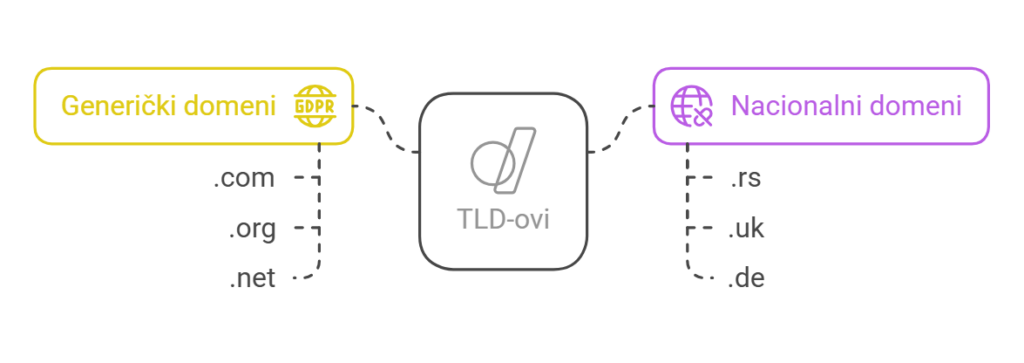
They are the most famous top level domains (TLD), which include .com, .org, .net, and specific national domains like .rs for Serbia.
TLDs are divided into:
- Generic (gTLD): These are generic domains that can be used by users worldwide.
- National (ccTLD): These are country specific and are usually used for local organizations.
In addition, there is subdomain which is used for additional sections within the main domain, such as blog.truefalsehosting.rs.
How the domain works
It functions as an address that allows users to access web content. DNS (Domain Name System).
This process involves several key steps:
- The browser sends the request after the IP address of the domain.
- DNS server finds the IP address and returns it to the browser.
- Search engine uses the resulting IP address to connect to the server hosting the web page.
Surfing the Internet is much easier, because users can easily remember and use domains instead of numerical addresses.
Domain registration
Domain registration is a key step for starting a business, working on the Internet. choosing the right name which will represent the website, as well as the technical aspects of the registration itself.
Choosing the right domain
When choosing a domain, it is important to choose a name that will be recognizable and related to the theme of the site. domain registration, it is recommended to focus on short and simple names that are easy to remember.
The domain maintains the brand identity or content to be offered.
Verifying the availability of the desired domain is the next step.
Registration process
The registration process is simple and includes several important steps.
After choosing the registry, the user should fill out the registration form, where he enters the desired domain name and his data.
After submitting the information, the user will receive confirmation of domain availability.
It is important to note that registration usually lasts for at least one year, with the option to extend.
What is hosting

Hosting is a service that enables web sites to be placed on the Internet. server space where site content is stored, allowing users to view and use it.
Types of hosting
There are different types of hosting that adapt to the needs of users.
Shared hosting:
With this option, multiple sites share the resources of the same server.
VPS hosting:
A virtual private server offers more resources and control than shared hosting.
It allows users to install their own software and customize the server according to the specific needs of their site, while keeping costs lower compared to dedicated hosting.
Dedicated hosting:
In this case, the user has the entire server to himself.
Dedicated servers are useful for e-commerce and applications that require custom configurations.
Cloud hosting:
This method uses virtual resources from multiple servers.
This type of hosting provides additional security because it does not depend on an individual server.
Choosing a hosting provider
Choosing the right hosting provider is one of the most important things when it comes to site performance.
- Prices and packages: Different providers offer different prices and options.
- Technical support: Good customer support can help solve problems.
- User reviews: The experiences of other users can provide insight into the quality of the service.
- Security measures: It is important that the provider offers adequate protection against attacks and regular backups.
Choosing the right hosting has a direct impact on the quality and success of your online presence.
Connection between domain and hosting

Domain and hosting are two basic elements for the functioning of a website.
Domain predstavlja jedinstvenu adresu veb sajta. Korisnici koriste ovu adresu da pronađu određeni sadržaj na internetu. Na primer, „truefalsehosting.rs“ je domen.
Hosting provides space on the server where all website data is stored. hosting services, the domain cannot display content.
In order for the site to be available, the domain must be associated with hosting.connecting domains and hosting".
In this regard, it is important to ensure that the DNS information is set correctly.
| Element | Description |
|---|---|
| Domain | Site address (e.g. truefalsehosting.rs) |
| Hosting | The server that stores the site files |
Associating your brand with the right domain and hosting is critical to the success of your online presence.
Domain and hosting management
Management includes regular maintenance of the domain as well as management of hosting resources, which enables the smooth functioning of the online presence.
Domain maintenance
The user must regularly check the domain registration status to avoid any interruptions in availability.
Important activities:
- Registration Renewal: Domain must be renewed before expiration to maintain control.
- Checking DNS settings: Making sure that the DNS information is set correctly allows the site to function properly.
- Security monitoring: Implementing an SSL certificate additionally secures the domain.
Regular domain maintenance ensures that visitors can always access the site without problems.

Management of hosting resources
Management of hosting resources implies optimization of the server and its capacities.
Key management points:
- Performance monitoring: Continuous monitoring can help identify problems before they become critical.
- Resource customization: It is recommended to adjust the level of hosting according to the needs of the site, such as increasing space or speed.
- Backup data: Backing up your data regularly is key to protecting against loss.
Correctly management of hosting resources contributes to the speed and security of the website, ensuring users a quality experience when visiting.
Frequently Asked Questions
How to register an internet domain?
Registration involves choosing a unique name and choosing a registry.
What types of web hosting are available in the market?
There are different types of web hosting on the market, including shared, VPS (virtual private server), dedicated and cloud hosting.
How to transfer a domain?
A domain transfer involves the transfer of a domain from one registry to another.
What are the benefits of using a local hosting provider?
Using a local hosting provider can bring faster support and optimized performance, as well as compliance with local regulations.