 Skip to content

What is an IP address and how does it work - a beginner's guide
An IP address (Internet Protocol Address) is a unique numerical identifier that enables communication between devices connected to a network, whether it's the Internet or a local network.
It can be seen as a digital address that allows data to be sent and received between computers, smartphones and server.

How do IP addresses work?
IP addresses work like addresses in the postal system - they allow data to reach the right destination.
For ease of use, numeric IP addresses are converted into understandable names through the DNS system (Domain Name System). domain, poput „example.com“.
Types of IP addresses
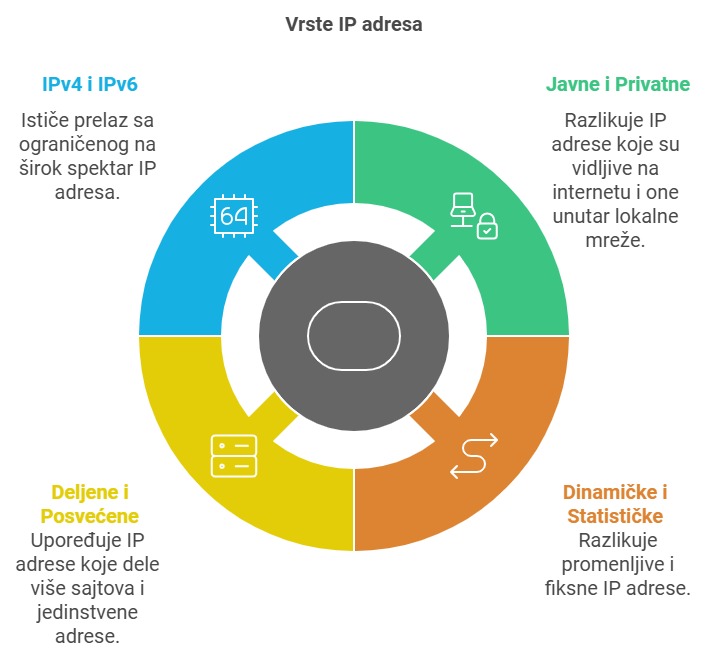
We divide them by function and application, and understanding the different types makes it easier to manage your network and connect devices.
- IPv4 and IPv6 addresses:IPv4 uses a 32-bit system, allowing for over 4 billion unique addresses, while IPv6, with a 128-bit system, provides an almost unlimited number of addresses, solving the problems of shortage of IP space.
- Public and private IP addresses: Public IP addresses enable communication outside the local network and are visible on the Internet.
- Allocation of IP addresses for websites: Shared IP addresses are shared between multiple sites on a shared hosting, while dedicated IP addresses enable unique site identification, which is useful for SEO and security.
- Dynamic and static IP addresses: Dynamic IP addresses change with each connection and are automatically assigned by the server, while static IP addresses remain unchanged and are used for devices with constant access, such as servers or printers.
Conclusion
IP addresses are necessary for the functioning of the Internet.