The Internet is an indispensable part of everyday life, and DNS (Domain Name System), which translates readable domain names into IP addresses.
DNS enables fast and accurate communication between devices and users, facilitating access to information.
Because of its key role, it remains an irreplaceable part of the Internet infrastructure.
Key points
DNS translates domain names into IP addresses.
It is crucial for the functioning of the Internet.
DNS records maintain protocol security and accuracy.
Basic concepts
DNS or Domain Name System allows Internet browsers to translate domain names into IP addresses, thus facilitating access to websites.
Definition of DNS
DNS je ključna komponenta interneta koja upravlja prevođenjem simbola u brojeve. Svaki web sajt ima jedinstvenu IP adresu, ali korišćenje tih adresa bilo bi nezgrapno za korisnike. Omogućava da lako pamtljiva imena domena, poput „primer.com“, zamene te brojevne adrese.
This convenience improves the user experience as it allows for easier navigation and access to the Internet.
It is also used for other types of translation, such as redirecting email addresses and different types of resources.
How does DNS work?
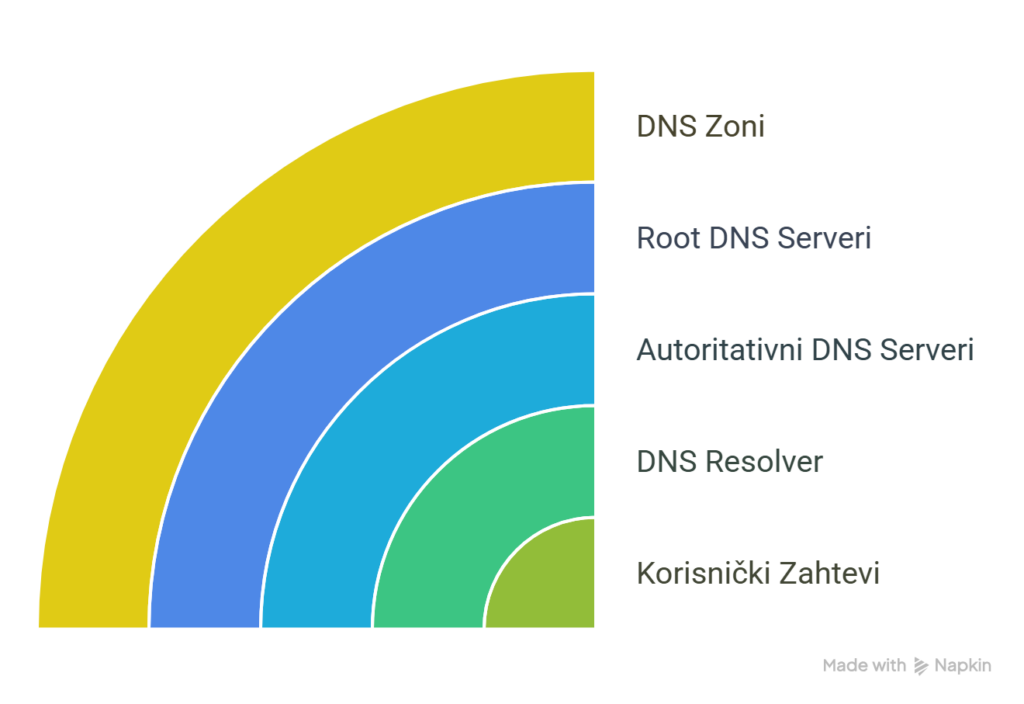
The DNS system works like the telephone directory of the Internet, translating domain names into IP addresses through a layered structure
The functioning of DNS relies on the distribution of information through different servers.
DNS is a hierarchical system where administration is done at different levels.
Ova organizacija omogućava brzu i efikasnu obradu zahteva. Takođe podržava „DNS zone“ koje omogućavaju logičko odvajanje domena radi lakšeg upravljanja, čineći sistem fleksibilnim i skalabilnim.
DNS Hierarchy level
Description Functions
User Requests
The user enters the site address into the browser - this triggers a DNS query.
DNS Resolver
The user's first contact with the DNS system.
Authoritative DNS Servers
They have the correct DNS records for the domain and correspond with the correct IP address.
Root DNS Servers
The highest level of the DNS system.
DNS Zones
They represent organizational units of the DNS space, they contain all information about domains within a certain zone (eg truefalsehosting.rs with all subdomains).
Significance in Internet infrastructure
The DNS system is a key component that enables the conversion of domains into IP addresses, which is necessary for communication between different devices on a network.
DNS and Internet connectivity
DNS servers process billions of requests per day, allowing users to access Internet content in milliseconds
DNS (Domain Name System) is a fundamental part of the Internet architecture that allows users to access web pages using easy-to-remember domains instead of numeric IP addresses.
DNS servers are distributed around the world, ensuring a high level of availability and stability, which is crucial for global connectivity.
Security aspects
DNSSEC (DNS Security Extensions) adds a layer of protection, ensuring that data between user and server is authentic.
DNS servers are often targets DDoS attacks, which may compromise availability.
DNS records and their role
There are several types of DNS records - A, CNAME, MX and TXT - each with its own specific role in the functioning of the Internet
DNS records are the basic elements in the DNS system that enable the association of domains with IP addresses.
Record types
DNS records define specific information about domains and IP addresses. And the record, which associates a domain with a specific IPv4 address. AAAA records are used to connect to IPv6 addresses.
CNAME records serve for aliasing one domain to another. MX records specify e-mail servers, while TXT records useful for ownership verification and security configuration.
NS records point to the DNS servers that are authoritative for the domain. SOA records provide administrative information, such as refresh times for DNS servers.
Understanding DNS Queries
DNS queries are the processes through which client devices request information from the DNS system. enter the URL into the browser, the client sends a DNS query to obtain the corresponding IP address.
If the information is not available, the Query is sent to the authoritative servers in a hierarchical way, starting with the root server, then the TLD server, and so on.
The efficiency and security of DNS queries depend on the correct configuration of DNS servers and records.
Frequently Asked Questions
Is it possible to use alternative DNS servers and what are the advantages?
Da, korisnici mogu konfigurisati svoje uređaje ili mreže da koriste alternativne DNS servere, kao što su Google DNS (8.8.8.8) ili Cloudflare DNS (1.1.1.1).
What is the relationship between VPN and DNS?
When use a VPN, DNS zahtevi mogu biti preusmereni kroz VPN servere kako bi se sprečilo „DNS leak“ – situaciju gde vaš stvarni DNS server otkriva lokaciju i identitet korisnika. Bez pravilne konfiguracije, DNS upiti mogu zaobići VPN i ugroziti privatnost
Šta je „DNS poisoning“ i kako se može sprečiti?
DNS poisoning (or cache poisoning) is an attack in which an attacker injects false information into a server's DNS cache, redirecting users to malicious sites.
Can DNS be used to block access to certain websites?
Yes, DNS filtering is a method to restrict access to certain domains.
How does DNS affect web page loading speed?
DNS resolution is the first step in loading a site.
Your privacy is important to us We use cookies to improve your browsing experience, deliver personalized ads or content, and analyze our traffic. cookie policy. By continuing to use the site and not selecting one of the options, you will be deemed to have opted out of the cookie policy
Functional cookies
Always active
Technical storage or access is strictly necessary for the legitimate purposes of enabling the use of a particular service that the subscriber or user has expressly requested, or solely for the purpose of transmitting communications via an electronic communications network.
Settings
Technical storage or access is necessary for the legitimate purpose of storing preferences not expressly requested by the subscriber or user.
Statistical cookies
The technical storage or access that is used exclusively for statistical purposes.Technical storage or access is required to create user profiles to send advertisements or track users on a website or across websites for similar marketing purposes.
Marketing cookies
Technical storage or access is necessary to create user profiles for the purpose of sending advertisements or tracking users on a website or across websites for similar marketing purposes.
 Skip to content